
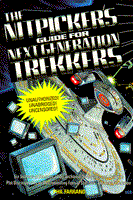
This was a loaner from my cousin in Missouri. I have to admit, I never thought I'd enjoy a book like this, but I am a trivia buff and much of what the author dug up was entertaining. He poked a lot of holes in continuity and in terms of on-going logic (invent something cool, never see it again, don't appreciate its ramifications). He also pointed out a lot of inconsistencies in ship design and other sorts of changes that most humans would never notice.
All in all, I'd rate this one a guilty pleasure if you enjoy all things Star Trek and have a penchant for the trivial. I owe Alan a good book, maybe something about real football (like the CFL) so he could appreciate that soccer or footie is a distinct sport but will never be 'football'.

Widowmaker
Mike Resnick wrote this one. Apparently there are an entire series of stories about the character Jefferson Nighthawk, a retired (or cryo-suspended if you prefer) bounty hunter and gunman, one of the nastiest killers on the Frontier.
The book is more about one of his (apparently several) clones, the idea being that people needed his skillset and he was too sick so they made a clone.
The clone exists to complete a mission but has a mind of his own. He's got the reflexes of the widowmaker, but the memories he gets quick loaded are from other people. He has the steel of a killer, but his (accelerated) upbringing doesn't make him an unthinking killer like his antecedent might be. He's a bit more naive as well. That said, he has his own mind and is as stubborn as the original and probably as deadly.
I liked this story because, like Serenity, it crosses the boundary between Western and SciFi. You could strip off the sci-fi and something of the sort could fit in a Klondike Gold Rush story. The characters act like Western novel characters and the flavour is there. There is enough of the sci-fi dressing to make it fit the scene, but that's just well applied varnish.
It's not the best book from a prose perspective and deep thought you probably won't get, but it is enjoyable and interesting for the way it ends. That made me want to find and read the others (before and after this one) in the series.

Cobra War!
I've moved through the third book of the Cobra War, but they've ended it with the need for either another book or a new trilogy (which is fine with me). If you are a fan of the franchise, you'll enjoy it. If not, you'll have to go back and do some homework because they don't rehash a lot of the history except in very slight references. Read the other books, it is a good ride to get to this point starting with "Cobra" itself.
I enjoyed this work but I knew I would as I enjoyed the others of the series. This book has the Aventinian and Caelian Cobras working hand in hand with their former enemy, the Quasamans and their Djinn to fight the invading Trofts. I won't spoil it, but these Trofts aren't the Trofts you are used to seeing through most of the other recent books and there is a really neat twist right at the end of the book tying back to the distant past that makes me even more anxious for the next one.
 To prove not everything I read is escapist drivel or absolute trivia (or both at once), I submit the other book I worried my way through: "Jutland 1916: Death in the Grey Wastes".
 This book works more to be a balanced narrative account of what happened to capture the flow of events rather than to focus on any one theory of what went right or wrong or to deal with any particular controversies or inconsistencies within accounts. It mentions briefly some of these, but it focuses mostly on giving the reader and accounting of who went where and did what and how well that worked out (or didn't).
The fascinating thing about this book is the clear explanation of how Dreadnaughts meeting even large, thousand plus man crewed pre-Dreadnaughts outclassed the prior designs by light years. What becomes quite clear here is it had to be nearly criminal to send out the pre-Dreadnaughts as they could not match slug-for-slug with the newer ships with their bigger guns, better fire control, belt armour, armoured decks, internal bulkheading and better fire suppression discipline. The book was also pretty graphic about what happened to light cruisers or destroyers that happened across Line of Battle vessels... and it was not pretty.
The other thing that is striking is how mundane some parts of the account were, like one of the head bakers on one of the ships working hard to save the bread after his ship's superstructure was shot to shards so that his surviving crew would eat something fresh, or the stories of the many underage (by today's standards) boys employed on such ships and their experience of this battle that would shake experienced Captains to the core.
Lastly, the account captures the power of PR in wartime. Scheer did not succeed in inflicting much of a defeat in detail on the Royal Navy nor of attriting is sufficiently to allow a subsequent even-strength clash between the German High Seas Fleet and the Royal Navy. He did succeed in escaping the trap he'd walked into, at least partly because of good training (his side practiced a bit of night fighting, the British did not) and partly because of a degree of luck. He did succeed in getting back to his home port first to tell the story which he put quite spin on.
Scheer played up the German outcome to the point where when Jellicoe and his Battle Line arrived home, there was little fanfare and some condemnation already apparent (from reports coming back out of Europe via the press). Jellicoe did the only strategically important thing for him to do (not lose enough of his force to be unable to contain the Germans or allow them to have an even strength clash) and yet he for quite a while was portrayed as the loser of the battle thanks in large part to Scheer's early characterization of the outcome. The media had power even in WWI Europe!
A good historical lesson that sometimes the loser can at least for a time be the winner if he courts public opinion effectively.
E-reader!
The last two above I read on my Kobo. That thing goes on and on without needing recharged and is a joy to read. Great buy and even better when I got it free from Chapters. My only bit of luck recently of a financial sort but a good bit nonetheless.
Works In Progress
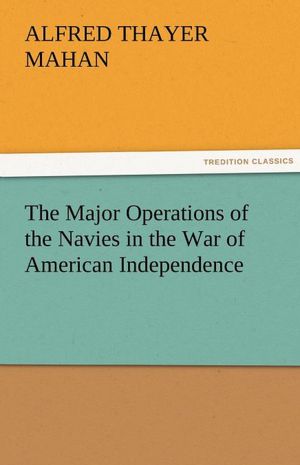
T.A. Mahan's "The Major Operations of the Navies of the War of American Independence" is one book I'm working my way through. I had no idea the Colonists were so fast off the mark and so hot-blooded at the start of the Revolution. I suppose they stole a march or two on the British to good effect by being so and I'm grateful for expanding my knowledge of North American history, something often taugh rather poorly in North American public schools. Perhaps much like mathematics or English.
I've discovered another interesting free T.A. Mahan book at Project Gutenberg. It has the long title "Types of Naval Officers (drawn from the History of the British Navy)" and seems like it may be worth a read for anyone interested in nautical matters.

This one has a foreward by noted author Mercedes Lackey about how this was the book that got her into Sci-Fi originally and how that inevitably lead to her being a Sci-Fi author.
I wonder, if I ever get published, if I'll be able to name my first read sci-fi novel. Star Wars, a New Hope? Something from RA Heinlein? Aasimov? I can name my first Fantasy Novel (LOTR!) but not sure I can name my first Sci Fi novel. Heinlein, Vonnegut, Asimov, L. Neil Smith and any number of others would have filled the early days.
Anyway, if this book is half as good as Schmitz other work, it'll be a great read.


 Posts
Posts


