Welcome to Animus Libri!

I plan to provide a series of useful book reviews as I mow through my endless queued book stack.

If I have spent the time to consume a book, I may be able to provide a few useful insights to others who may be thinking of buying the book. Alternatively, I may be able to alert people to books which they would otherwise be unaware of and that they may enjoy.

Books reviewed will be of a very diverse variety. I hope to be able to capture the spirit and soul of these books, at least sufficiently enough to help any readers decide if the book would be of interest to them. I'll also try hard not to spoil the storylines of any fiction or non-fiction story.

Below, you will find lists of books currently being actively read, bookmarked (partially read but currently not being actively consumed), and waiting to be read.

21 March 2012

Review: Monster Hunter International

Monster Hunter International could best have been titled 'Gun Porn Meets Deadly Mythical Monsters'. Larry Correia certainly wrote what he knows, being a competitive shooter, gunsmith, and general gun afficionado (nut sounds prejudicial).

On the plus side, the monsters are bad. Not bad as in poorly done, bad as in 'badass'. There are no sparkly vampires here. There is no urbane hedonist with whom to have a long philosophical discussion. There are bloodsucking undead monsters and their minions. There are creatures from fantasy that are and are not what you would expect. There are horrors from beyond our mortal realm that have the distinct odeur of Lovecraftianity. (Yes, I just invented a word.... but it was better than Lovecraftiness...)

While I'm not 100% fond of Larry's 'gun porn', that could just be me. Oddly enough, I used to like this kind of thing when I was a teen, but enough time with professional soldiers and police and one too many John Ringo volumes showering deep and abiding love upon the minutiae of firearms specifications kind of shattered my interest in that and it appears not to be healing.

I also wasn't fond of the life story of our hero. I'm not going to spoil it here, but simply let us say that to hunt monsters, you have to be badass. Badass is okay. Badass and accountancy just aren't. A number of apsects of the hero's backstory tried to explain the combination and the raison d'etre for that reality, but it came off feeling still incredibly unlikely.

The nature of hunting such supernatural beasties requires the hunters be nigh supernatural themselves (in competence, in will, in experience and skills, and perhaps in other respects). It's probably because I've always gotten more from stories of how average men rise above their humble roots to be something more that I don't find hero background tales with nobility, rich family, overachieving honours student, super martial arts master, etc. to make for terribly interesting protagonists, even if they don't acknowledge their gifts for some lengthy stint.

I also found some of the plot twists rather obviously telegraphed (that may have been intentional, but I can certainly say it was suspensful) and others less obviously telegraphed were equally predictable. 

But those are my major complaints and they still won't stop me giving the book a 7/10 overall rating. If I had to decompose that, I might give it a 6/10 on character origin and development, mostly because I wasn't fond of the main protagonist but did like many of the supporting players, a 7/10 on plot due to some of the telegraphing, and a 9/10 on narrative style.

Narrative style is Larry's strongest asset as a writer in my opinion. His narrative reads easily and it has a certain mojo to it. That's not a very technical term, but it feels like the right term because when you read it, you do kind of get sucked in and the pages flow by (even though there are a lot of them in MHI). I didn't find his prose made me want to skip over sections or use the book to suffocate myself. Overall, I quite enjoyed the read.

I think the work is good enough to have me consider picking up the second one (Monster Hunter Vendetta). There's a third one in the series, but I think I want to take this one book at a time, even though the third one focuses on one of the more interesting characters from MHI.

If you do enjoy technically detailed firearms discussions, that probably won't bug you like it did me. If you more easily accept truly exceptional hero backgrounds, that probably won't bother you either. You'll glide smoothly through Larry'a narrative unless perhaps you have a pro-authority/anti-libertarian sort of outlook since Larry's MHI characters are about as anti-government as you can get without being in a militia blowing up government buildings. Now, in their defense, his Feds are the sort of characters few might like, even if they do think they're doing what they do for the right reasons.

If you enjoy scenes of evil critters getting their just deserts from desperate heroic characters, then MHI is just the book for you. No sparkles. No teenage vampire angst. Just a lot of throw down, beat down, blow down and burn the bits fights. Car chases. Airborne adventures. Dungeon delving. You name it, it's there. Larry knows how to weave a good pulp adventure tale - disparate and unique locations, each of which becomes a life-or-worse-than-death battleground with dramatic heroics and sacrifice at every turn.

I'm going to probably pick up the next one in a short time and see where this road leads. You may want to do the same.

09 March 2012

More pages fall before me!

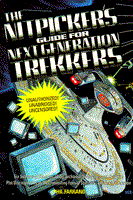
Nitpicker's Guide for Next Generation Trekkers

This was a loaner from my cousin in Missouri. I have to admit, I never thought I'd enjoy a book like this, but I am a trivia buff and much of what the author dug up was entertaining. He poked a lot of holes in continuity and in terms of on-going logic (invent something cool, never see it again, don't appreciate its ramifications). He also pointed out a lot of inconsistencies in ship design and other sorts of changes that most humans would never notice.

All in all, I'd rate this one a guilty pleasure if you enjoy all things Star Trek and have a penchant for the trivial. I owe Alan a good book, maybe something about real football (like the CFL) so he could appreciate that soccer or footie is a distinct sport but will never be 'football'.

 
Widowmaker
Mike Resnick wrote this one. Apparently there are an entire series of stories about the character Jefferson Nighthawk, a retired (or cryo-suspended if you prefer) bounty hunter and gunman, one of the nastiest killers on the Frontier.

The book is more about one of his (apparently several) clones, the idea being that people needed his skillset and he was too sick so they made a clone.

The clone exists to complete a mission but has a mind of his own. He's got the reflexes of the widowmaker, but the memories he gets quick loaded are from other people. He has the steel of a killer, but his (accelerated) upbringing doesn't make him an unthinking killer like his antecedent might be. He's a bit more naive as well. That said, he has his own mind and is as stubborn as the original and probably as deadly.

I liked this story because, like Serenity, it crosses the boundary between Western and SciFi. You could strip off the sci-fi and something of the sort could fit in a Klondike Gold Rush story. The characters act like Western novel characters and the flavour is there. There is enough of the sci-fi dressing to make it fit the scene, but that's just well applied varnish.

It's not the best book from a prose perspective and deep thought you probably won't get, but it is enjoyable and interesting for the way it ends. That made me want to find and read the others (before and after this one) in the series.
 

Cobra War!

I've moved through the third book of the Cobra War, but they've ended it with the need for either another book or a new trilogy (which is fine with me). If you are a fan of the franchise, you'll enjoy it. If not, you'll have to go back and do some homework because they don't rehash a lot of the history except in very slight references. Read the other books, it is a good ride to get to this point starting with "Cobra" itself.

I enjoyed this work but I knew I would as I enjoyed the others of the series. This book has the Aventinian and Caelian Cobras working hand in hand with their former enemy, the Quasamans and their Djinn to fight the invading Trofts. I won't spoil it, but these Trofts aren't the Trofts you are used to seeing through most of the other recent books and there is a really neat twist right at the end of the book tying back to the distant past that makes me even more anxious for the next one.

To prove not everything I read is escapist drivel or absolute trivia (or both at once), I submit the other book I worried my way through: "Jutland 1916: Death in the Grey Wastes".

This book works more to be a balanced narrative account of what happened to capture the flow of events rather than to focus on any one theory of what went right or wrong or to deal with any particular controversies or inconsistencies within accounts. It mentions briefly some of these, but it focuses mostly on giving the reader and accounting of who went where and did what and how well that worked out (or didn't).

The fascinating thing about this book is the clear explanation of how Dreadnaughts meeting even large, thousand plus man crewed pre-Dreadnaughts outclassed the prior designs by light years. What becomes quite clear here is it had to be nearly criminal to send out the pre-Dreadnaughts as they could not match slug-for-slug with the newer ships with their bigger guns, better fire control, belt armour, armoured decks, internal bulkheading and better fire suppression discipline. The book was also pretty graphic about what happened to light cruisers or destroyers that happened across Line of Battle vessels... and it was not pretty.

The other thing that is striking is how mundane some parts of the account were, like one of the head bakers on one of the ships working hard to save the bread after his ship's superstructure was shot to shards so that his surviving crew would eat something fresh, or the stories of the many underage (by today's standards) boys employed on such ships and their experience of this battle that would shake experienced Captains to the core.

Lastly, the account captures the power of PR in wartime. Scheer did not succeed in inflicting much of a defeat in detail on the Royal Navy nor of attriting is sufficiently to allow a subsequent even-strength clash between the German High Seas Fleet and the Royal Navy. He did succeed in escaping the trap he'd walked into, at least partly because of good training (his side practiced a bit of night fighting, the British did not)  and partly because of a degree of luck. He did succeed in getting back to his home port first to tell the story which he put quite spin on.

Scheer played up the German outcome to the point where when Jellicoe and his Battle Line arrived home, there was little fanfare and some condemnation already apparent (from reports coming back out of Europe via the press). Jellicoe did the only strategically important thing for him to do (not lose enough of his force to be unable to contain the Germans or allow them to have an even strength clash) and yet he for quite a while was portrayed as the loser of the battle thanks in large part to Scheer's early characterization of the outcome. The media had power even in WWI Europe!

A good historical lesson that sometimes the loser can at least for a time be the winner if he courts public opinion effectively.

E-reader!

The last two above I read on my Kobo. That thing goes on and on without needing recharged and is a joy to read. Great buy and even better when I got it free from Chapters. My only bit of luck recently of a financial sort but a good bit nonetheless.


Works In Progress


T.A. Mahan's "The Major Operations of the Navies of the War of American Independence" is one book I'm working my way through. I had no idea the Colonists were so fast off the mark and so hot-blooded at the start of the Revolution. I suppose they stole a march or two on the British to good effect by being so and I'm grateful for expanding my knowledge of North American history, something often taugh rather poorly in North American public schools. Perhaps much like mathematics or English.

I've discovered another interesting free T.A. Mahan book at Project Gutenberg. It has the long title "Types of Naval Officers (drawn from the History of the British Navy)" and seems like it may be worth a read for anyone interested in nautical matters.

I'm also working through "Agent of Vega" by James H. Schmitz as re-released by Baen. This is a re-release of the 1960 classic. It focuses on espionage and the work of Zone agents within the larger tapestry of the Schmitz universe where characters like Telzey and Trigger from his other works roam. I've enjoyed every other Schmitz reprint.

This one has a foreward by noted author Mercedes Lackey about how this was the book that got her into Sci-Fi originally and how that inevitably lead to her being a Sci-Fi author.

I wonder, if I ever get published, if I'll be able to name my first read sci-fi novel. Star Wars, a New Hope? Something from RA Heinlein? Aasimov? I can name my first Fantasy Novel (LOTR!) but not sure I can name my first Sci Fi novel. Heinlein, Vonnegut, Asimov, L. Neil Smith and any number of others would have filled the early days.

Anyway, if this book is half as good as Schmitz other work, it'll be a great read.

29 July 2011

Waded through another book on my backlog....


I had picked up another book about Vorkosigan with some reluctance. I have several friends that consider Lois McMaster Bujold's writing style to be delectable, so I once again tested the waters.


Capsule Review:

It must just be me, but I find Bujold's writing style to be somewhat self-indulgent and flowery for the genre of military SF. Some amount of that can be hand-waved away by saying that the main character Miles Vorkosigan is a very different sort of fellow - intense, driven, intellectual, etc. Some amount of it can be hand-waved away by realizing the book is about military and espionage covert operations more or less made up on the fly if such a thing makes any sense. And still, I find it a bit much.

I did learn a couple of new words, which I find enjoyable (swive and uxorial). But then, betimes I enjoy reading a dictionary, so I might just not be the average reader.

The story itself was not glaringly problematic. I did see a bit of (depending on your taste) incredibly ingenious plotting or incredibly contrived plotting in how the main challenge appeared and was dealt with.

I also take an issue with this due to the genre the book was written in (military and/or espionage SF). I've met a fair number of people from both modern communities of that ilk and it seems to me Vorkosigan is not fit for the work. His personality type (self-doubting, somewhat flighty as his mind flits from worry to worry, and rather glibly chatty) does not fit with the members of either profession.

In some sense, that may be the point; Miles is a fish of a different variety. That said, I think he would not survive the actuality of such operations. I just don't find him believable in the role. I find many of the leaps of logic he makes rather unlikely and I cannot shake the feeling that he would be busted out of the service. The books make lip service to the latter threat, trading against his Imperial bloodline in many cases or the success of his unconvential operation as the bromide. My experience of the sort of people who work in both the espionage and covert special operations realms (or the broader combat arms) is that they are not the sort to excuse bad process and poor craft simply based upon good results so far.


Will many readers enjoy the book? I don't doubt it, in the same way many readers enjoy Stainless Steel Rat or similar works. This work has the same improvisational plotlines that make for a fun read, if you happen not to know how the real professions work or the sorts of people that populate them (and most people do not have those sorts of connections).

I enjoyed the book well enough, but I did regularly have to beat down the little voice saying 'that wouldn't fly' or 'that was convenient' or 'person X I know would have thought about having this guy shot'.

Perhaps I judge too harshly and this is meant to be more of an adventure story than military SF. But the story cloaks itself in that sort of accoutrement so against that background I judge it.

Overall, I'd say it is about a 3 out of 5. If you need to fill some time, its not a bad read. But this author has not impressed me enough to buy another of these books.